
In my mind, some of the best acting I have ever done happened in the very first days of rehearsal. So many theatre terms I was not familiar with. So many people nodding eagerly, smiling with understanding, and quickly jumping to action. And me right with them.
Community theatre runs on a shared vocabulary that can be pretty confusing unless you've gone to school for theatre. You show up for your first rehearsal, the director calls "places from the top of Act Two, drop the scrim after the spike is set," and you smile and nod and have absolutely no idea what just happened.
Most of us pieced it together over years of rehearsals, gentle corrections (or not so gentle if we don't get out of the way of the fly quickly enough), and a few embarrassing moments. It doesn't have to work that way.
Here are fifteen terms that consistently confuse newcomers (and occasionally trip up veterans). Some are spatial. Some are procedural. A few have histories worth knowing. All of them will come up at your next production.
1. Upstage and Downstage
These seem backwards. "Upstage" feels like it should mean the front of the stage (prominent, elevated), and "downstage" feels like it should mean the back. In fact, it is the reverse: downstage is toward the audience, and upstage is toward the back wall.
The reason is historical and entirely logical once you know it. Before modern flat stages, theatre stages were raked (tilted toward the audience) so the audience could see the back of the stage over the heads of the front-row performers. The back of the stage was literally higher than the front. Up the slope meant upstage. Down the slope meant downstage.
Modern stages are usually flat, but the vocabulary stuck. When a director tells you to "cross downstage," they mean walk toward the audience.
This is also where the phrase "upstaging someone" comes from. If an actor moves upstage during a two-person scene, the other actor has to turn their back to the audience to maintain eye contact with them. The upstage actor is now facing the house; the downstage actor is facing the wall. The upstage actor has stolen the focus. It is considered bad form, and experienced actors do not do it accidentally.
2. Cross
A cross is a deliberate movement from one position to another on stage. "Cross downstage left after the line" means walk to that position at that moment. "There should be a cross somewhere in this scene" means a movement needs to happen. It works as both a verb and a noun.
The distinction between a cross and just walking around matters more than it sounds. A cross is a decision: it belongs to the blocking, it happens at a specific beat in the text, and it means something. An actor who wanders on their own impulse is not making a cross. They are, in all likelihood, making a problem. (Ask me how I found THAT out!)
3. Stage Right and Stage Left
Theatre, as every actor in theatre will eventually remind you, revolves around the actor. So it makes sense that stage directions are given from the actor's perspective. An actor stands on stage facing the audience (as they should). To their right is stage right. To their left is stage left.
This means stage right and stage left are the reverse of what the audience sees. When an audience member thinks "she's on the left side of the stage," the actor is actually on stage right. Knowing this one early saves a lot of confused scrambling.
4. The Wings
The wings are the off-stage areas to the sides of the performance space, hidden from the audience by masking. This is where actors wait for their entrances, where props are staged for quick pickup, and where the assistant stage manager typically runs the show from their desk during a performance.
"In the wings" means standing just off stage, ready to enter. A nervous performer waiting for a cue is in the wings. A director watching from the side is in the wings. It is crowded, often dark, and almost always full of people trying not to bump into each other.
5. Scrim
A scrim is a loosely woven fabric hung as a curtain or backdrop. Its defining trick is what happens when you change the lighting: when lit from the front, a scrim appears opaque and you can paint or project onto it. When the front light fades and a light source is placed behind it, the scrim becomes transparent and whatever is behind it is revealed to the audience.
It is one of the most visually striking effects in theatre, and it depends entirely on the fabric and the lighting. No moving parts, no machinery. Just cloth and light. The first time you see it work in a tech rehearsal, it feels like magic. The first time someone tells you it is called a scrim and you have been nodding along for weeks, it feels like relief.
6. The Fly (and The Flies)
The fly (or fly loft, or flies) is the space above the stage, above the audience's sightline, where scenery, curtains, and lighting can be raised out of view. When something is "flown out," it has been raised up and is no longer visible. When it is "flown in," it descends to stage level.
Flying scenery in and out is one of the defining tricks of traditional theatre production. A full backdrop can vanish in seconds, replaced by a completely different scene. Not all theatres have fly systems (black boxes and smaller venues often don't), but a theatre with a full fly loft has a production capability that community companies use extensively in musicals.
7. Ghost Light
A ghost light is the single bare bulb on a stand left illuminated on stage when the theatre is dark and empty. It is one of those theatre traditions where the practical and the poetic have merged completely.
The practical reason: a dark stage is a hazard. Open trap doors, orchestra pits, cables, set pieces in unexpected positions. The ghost light means no one walks into the dark and falls into the pit.
The theatrical story that has grown up around it: theatres have ghosts, and the ghost light gives them something to perform to. Whether you believe it or not, every theatre person treats the ghost light with a certain quiet respect. It stays on whenever the stage is dark and empty. The only time it comes down is when the stage is in use.
8. Green Room
The green room is the backstage lounge where performers wait when they are not needed on stage. It is where people run lines, eat, argue about the blocking, and try not to think about how many people are about to watch them perform.
Why "green"? Nobody fully agrees. The leading theories involve the color of early stage lighting (which required green-painted spaces to neutralize the tint), or simply that one early famous theatre happened to have a green room and the name spread. The name has outlasted any original reason, and most green rooms are not green. Some are beige. Many are aggressively beige.
9. The House (and House Lights)
"The house" has several related meanings. The house is the seating area where the audience sits, as opposed to the stage. A "full house" means every seat is taken. "Working in the house" means a director or designer is sitting in the seating area rather than on stage.
House lights are the lights that illuminate the audience seating area. "House lights at half" is the signal that the show is about to begin. When the house goes to black, the performance starts.
"How's the house tonight?" is the most common pre-show question. It means: how many people are out there?
10. Blocking
Blocking is the planned movement of actors on stage: where they go, when they cross, where they stand for key moments. The director creates the blocking during early rehearsals, and actors write it in pencil in the margins of their scripts.
"Blocking rehearsal" means the director is choreographing movement, not working on performance quality. "We're setting blocking tonight" means you will need your script and a pencil. "Is that in your blocking?" means: did the director tell you to do that, or are you making it up?
Good blocking tells a story through space. Bad blocking has everyone standing in a line facing front.
11. Spike Marks
Spike marks (or just "spikes") are pieces of colored tape on the stage floor marking where furniture and set pieces need to be placed during scene changes. When a crew member "spikes" a chair, they put tape marks at each leg so the piece can be positioned correctly in the dark, quickly, during a transition.
They are not visible to the audience. They are extremely important to the crew. Moving a spike without telling anyone is one of those small acts that can derail a scene change completely.
12. Off-Book
Off-book means the actor has memorized their lines and no longer needs to carry the script during rehearsal. The transition from on-book (script in hand) to off-book (script put away) is one of the key milestones of the rehearsal process.
The "off-book date" is when the director expects everyone to have their lines memorized. Missing the off-book date is the kind of thing that creates tension in a cast. Being off-book early is the kind of thing that makes directors quietly relieved.
13. Tech Week
Tech week is the final week of rehearsals before opening, when the technical elements (lights, sound, scenery, costumes) are integrated with the performance for the first time. It is also called "Hell Week" by everyone who has been through it.
Tech week is where everything that was planned in isolation meets everything else simultaneously. For many community theatres, it is the first time the actual stage lights have been used at all. Lighting cues that existed only as numbers on a board now hit props that are really there. Things that should work do not. Things nobody anticipated become problems. Tech week runs long, ends late, and tests every relationship in the company.
On the other side of tech week is opening night. It is always worth it. People keep coming back.
14. Places
"Places" is the call for all actors to take their positions for the top of the show, or the top of an act. When the stage manager calls "places," the performance is about to begin and everyone needs to be exactly where they need to be for the first moment.
Before "places" comes the countdown: "thirty minutes," "fifteen minutes," "five minutes," then "places." This sequence comes from the stage manager and is the spine of every performance. When you hear "places," the show is real.
15. The Fourth Wall
The fourth wall is the imaginary boundary between the stage and the audience. A proscenium stage has three physical walls (back and two sides). The fourth wall is the open front: the invisible surface through which the audience watches.
In conventional theatre, actors behave as if the fourth wall is real and the audience is not there. "Breaking the fourth wall" means acknowledging the audience directly. A character speaks to them, a narrator steps out of the story, a comedian addresses the crowd.
Community theatre tends toward fourth-wall-intact drama for most productions. But the moment an actor directly addresses the house, something shifts. The audience knows they have been seen. Used well, it is one of the most powerful tools in the form.
Bonus: Break a Leg
"Break a leg" is how you wish a performer good luck before a show. You do not say "good luck." Saying good luck in a theatre is considered bad luck. It sounds like a joke until the first time you say it accidentally and watch the room react.
The most widely repeated origin connects to the architecture of the stage. The vertical masking panels on the sides of the stage are called legs. To actually perform is to cross through that line, to break it. "Break a leg" was a wish that the performer would make it through those curtains and onto the stage.
A competing theory comes from vaudeville, where performers were only paid for shows they actually went on. Breaking the leg line meant getting paid. The phrase was a genuine wish for work.
Whatever the true origin, the rule against saying "good luck" is treated seriously. Most theatre people will not even say it ironically. If you are backstage before a show and want to say something encouraging, now you know what to say.
It is also how Broken Leg Software got its name. When we were building the software that would eventually become Odeumate, we named the company before the product had a name. "Broken Leg" was a nod to the world we were building for.
Theatre vocabulary is a living language, shaped by centuries of accumulated practice, superstition, and borrowed words from industries that no longer exist. Learning it is part of joining the community, and there is no test. You pick it up over seasons, one rehearsal at a time.
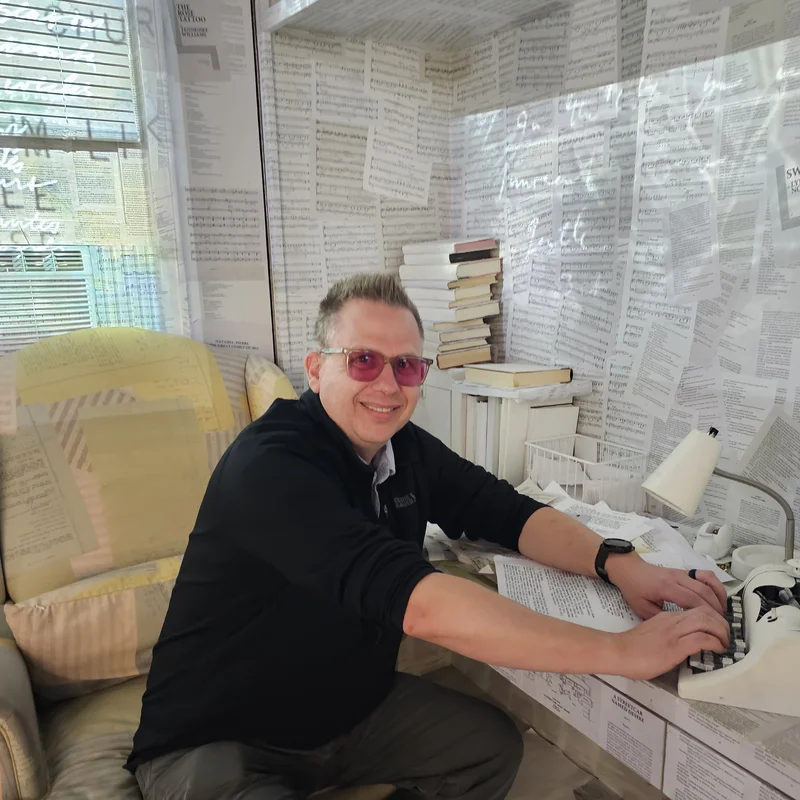
Photo: Museum of Broadway, New York
Glenn Howard is a co-founder of Odeumate and serves on the board of Chilliwack Players Guild. He has spent 30 years in IT and nearly as long on stage, and he built Odeumate because nothing else existed.