

You got the script. You found a quiet corner of your house, made a cup of tea, sat down to read through your new show, and ran directly into this:
FRANK crosses downstage right and sits on the settee, back to HELEN, who moves upstage center as the lights shift.
You're sitting on a couch. There's no stage, no settee, no Helen, and no lights to shift. You have a read-through in four days.
Reading a script at home is a skill, and most community theater performers were never formally taught it. I'm not a trained actor, and many of the people I've shared a stage with aren't either. We figure it out through coaching, corrections, and quietly trying to keep up with the ones who were. This guide covers what most people learn the hard way, before you need it.
The Core Vocabulary
Stage directions use spatial vocabulary built around a specific set of conventions. They aren't intuitive unless someone explains them.
Downstage is toward the audience. Upstage is toward the back wall. (If this feels backwards, see 15 Theatre Terms That Trip Everyone Up for the historical reason. Short version: stages used to be raked, and the back was literally higher than the front. The vocabulary stuck.)
Stage right is to your right when you're facing the audience. Stage left is to your left from the same position. Stage right and stage left are always from the actor's perspective, which means they're the reverse of what the audience sees.
These four terms combine to describe nine zones of the stage.
The Nine-Zone Grid
Picture a three-by-three grid. Label it from the actor's perspective, facing the audience:
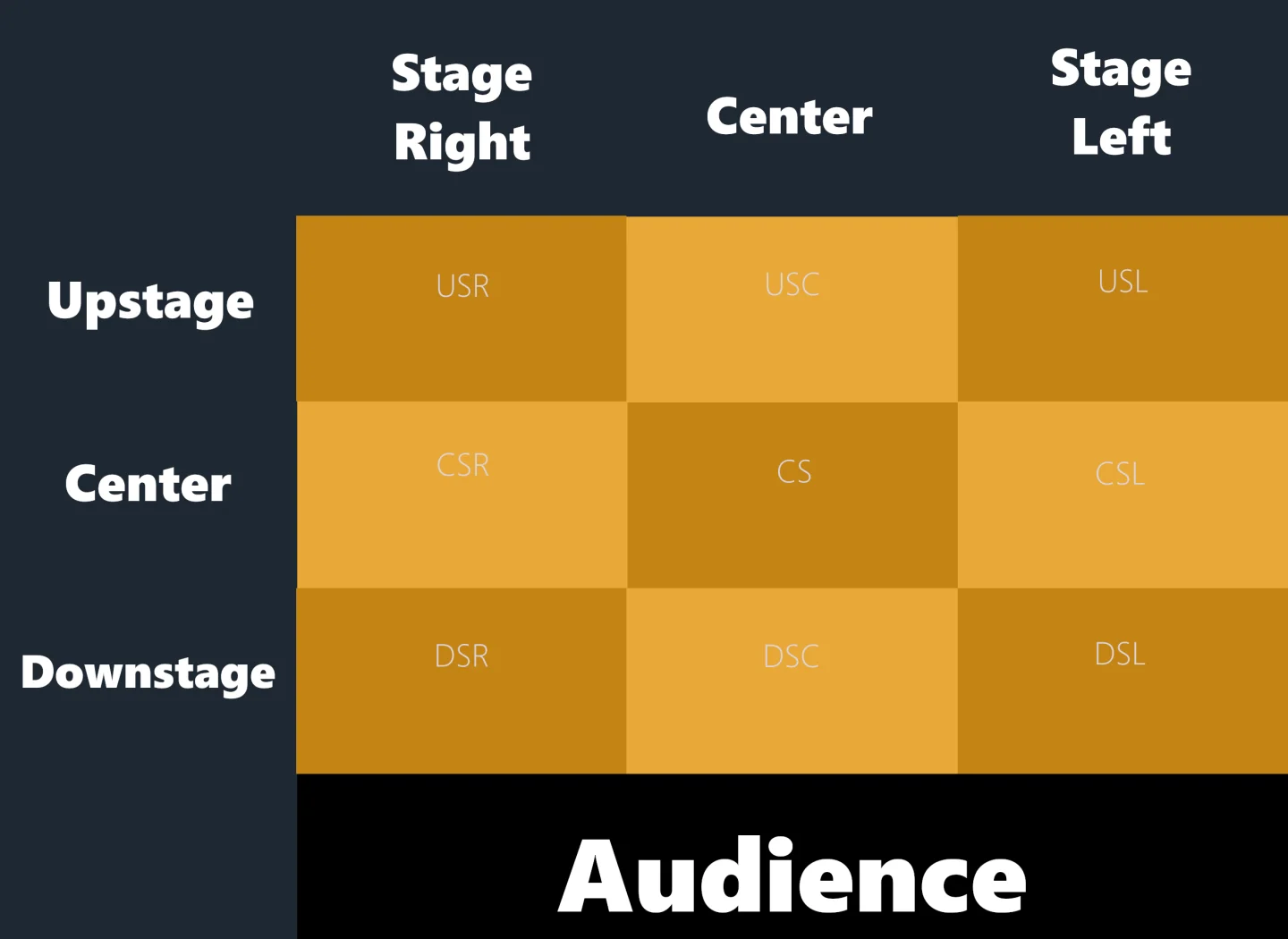
US = Upstage, DS = Downstage, C = Center, SR = Stage Right, SL = Stage Left.
Center Stage (CS) is the middle of the performance space. Downstage Center (DSC) is directly in front of the audience. Upstage Right (USR) is the back corner on your right. Once you have this grid in your head, any direction becomes a precise location. "Cross to DSL" tells you exactly where to go. "Standing at USC" tells you exactly where someone is.
You won't find the grid labeled on the floor. But experienced directors and stage managers assume everyone knows it, and being able to respond to zone references without hesitation is one of those small things that makes the early days of rehearsal go more smoothly.
Two Kinds of Stage Directions
This is the distinction that matters most when you're reading at home.
Playwright stage directions are written by the person who wrote the script. They describe what the playwright imagined when they wrote the scene: where characters are standing, how they move, what the set looks like. In a published script they appear in italics, usually in parentheses:
(Helen crosses to the window, looks out for a moment, then turns.)
These are guidance, not gospel. Your director may follow them, modify them, or ignore them entirely. The playwright imagined a production. Your director is creating a different one. When you read playwright stage directions at home, read them for context (what's the character doing emotionally? what's the physical atmosphere of the scene?) rather than as literal instructions.
Blocking notes are different. These are the movement instructions your director gives you in rehearsal, which you write in pencil in the margins of your script. "Cross to DSR on that line." These you follow exactly, and they override the playwright's directions.
At home, before you have any blocking, you're reading playwright directions only. Read them for story, not for execution.
How to Sketch as You Read
When a scene introduces a new location, take thirty seconds to rough out a floor plan on a scrap of paper. You don't need accuracy, and you don't need to match the playwright's directions precisely. You just need a spatial anchor.
Mark the downstage edge with a line (where the audience sits). Mark any major features the script mentions: a door, a window, a table, a couch. You don't need exact furniture placement, just landmarks.
Now when a direction says "he moves to the window," you know roughly where the window is. The space starts to exist in your head.
This is especially useful in scenes with multiple characters positioned relative to each other. A quick sketch tells you who is upstage of whom, who is closest to the exit, who is isolated in a corner. That spatial picture informs how you understand the scene even if the blocking you eventually receive looks nothing like it.
Tracking Other Characters While Reading Your Own
When you're reading, your attention naturally goes to your character's lines and the lines you're reacting to. The other characters' movements become background noise.
But position matters. A character who has moved upstage of you before a key line is effectively behind you. A character who has crossed to the opposite side of the stage is far away during what might be an intimate moment. These things shape how a scene reads and how your character experiences it.
As you encounter stage directions involving other characters, add a rough mark to your sketch to track where everyone ends up by the end of a scene. "Where is everyone when I say this?" is a question worth being able to answer before you walk into rehearsal.
Visualizing a Cross
A cross is a movement from one point on stage to another. "Helen crosses to John" means she moves to wherever John is standing. "Frank crosses downstage and turns" means he moves toward the audience and faces them.
When you read a cross at home, picture it in terms of the grid. Where does the character start? Where do they end up? Does the path take them through the center of the scene or around its edges?
Pay attention to when the cross happens relative to the lines. A cross during a speech is common and specific: the character is moving and talking at the same time, which tells you something about the scene's energy. A cross in silence between speeches is different: the movement itself is the moment. Both are worth noticing before you get to rehearsal.
A director once told me that why a character crosses changes how they cross. That story is here, but the short version is that a cross is never just logistics.
A Few Practical Habits
Read the whole script first without stopping. On the first pass, don't try to absorb every stage direction. Read for story, character, and the shape of the narrative. Go back on a second read for the spatial picture.
Pencil only, always. Everything you write in your script is subject to change in rehearsal. Blocking notes will be rewritten multiple times before opening. Pen is a commitment your director will undo for you.
Keep playwright directions visually separate from your blocking notes. Some actors use different margins or colors to distinguish between "the playwright imagined this" and "the director told me to do this." Whatever system works for you, make sure you can tell them apart at a glance.
Don't memorize before you have blocking. Read for understanding first. Memorizing lines against the wrong blocking makes the right blocking harder to absorb. Let the lines come through the rehearsal process, not in advance of it. The payoff is that once you have both, they reinforce each other. By opening night, the movement and the words are the same memory.
Reading a script at home is the beginning of a longer conversation. The full shape of a scene emerges in the room, with the other people, on the actual stage. What at-home reading gives you is a prepared imagination: a sense of the story's geography, the characters' positions relative to each other, and the rhythm of how a scene moves.
You can't know exactly where you'll stand or how the director will use the space. But you can show up knowing the vocabulary, ready to respond to direction without spending the first rehearsal catching up. That's worth the quiet hour at home with a sketch pad and a pencil.
Photo: Museum of Broadway, New York
Glenn Howard is a co-founder of Odeumate and serves on the board of Chilliwack Players Guild. He has spent 30 years in IT and nearly as long on stage, and he built Odeumate because nothing else existed.