
When I am asked to do sound design for a show, or to run sound for one, there is a question I want answered before almost anything else: are we mic-ing this?
It is not a small question. The answer changes the budget, the crew, the rehearsal schedule, what the cast needs to learn, and what can go wrong on any given night. It changes everything about the show. Glenn wrote about this from the actor's side in Tales from the Stage, and he is right that the whole pre-production workflow is different depending on the answer, for the cast and the crew both. What I can offer is the view from the booth.
Starting with an answer that tends to surprise people.
A sound guy whose default is no mics
My default is not to mic. Yes, really. The guy who loves the gear would rather leave it in the cases.
If at all possible, I want to let the actors perform. A cast that can carry the room on their own voices gives the audience something amplification can only imitate. And as Glenn described, mics put a stress on actors that does not need to be there if the room does not demand it. When a show can live without wireless, my job gets simpler and the show gets more honest. I handle the effects and the music, and I stay out of the way of the storytelling.
But a default is not a rule, and I have been burned by mine.
The small show I got wrong
I did sound design for a small production in an intimate venue. The kind of room where you would assume no mics, and that is exactly what I assumed. I should have mic'd the cast.
The show was staged in the round. Every actor had their back to half the audience, all the time. No projection technique fixes that; the voice goes where the face points. Glenn, who happened to be in that cast, has argued that a small room does not need mics. This one did.
I felt it in the booth too. I was running sound cues, and when the actors faced away from me I could not hear them clearly, and I could not fall back on watching their mouths to know when to go. If the operator is straining to follow the dialogue, so is the half of the audience the actors are facing away from.
So the question is never just "how big is the room." It is the room, the staging, the cast, the show, and the budget. Which brings us to the part nobody enjoys talking about.
"Mic-ing the show" is a menu, not a switch
When people say mics, they almost always mean close mic-ing: an individual wireless mic on an individual actor. That is one option, and it is by far the most expensive one. You need a lot of mics, and as I will get to, they need to be good ones.
But there are other ways to reinforce a show, and each one earns its keep somewhere and bites you somewhere else. Boundary mics laid along the stage edge can lift a whole playing area, but they hear everything the stage does: footsteps, prop drops, a chair scraping the deck, all amplified right along with the dialogue, and the amount of lift you can get before feedback is limited. A shotgun mic can cover a zone of the stage, but only the zone it is aimed at, and an actor picked up from twenty feet away will always sound like an actor picked up from twenty feet away. Sometimes a handheld is exactly the right tool, for a narrator or a song. A wired one on a stand nails the performer to one spot on the stage; a wireless handheld is free to roam. All of these work; some work better in one environment, others in another. The question I keep coming back to is simple: what am I trying to accomplish here? The goal is always for the sound to be natural, so natural the audience never once thinks about the speakers. Whatever option gets this room, this show, and this budget to that result is the right one.
No mics beats cheap mics
Community and school theatres are notoriously tight on budget, and that will shape the show. Good gear costs a lot. I mean a really huge amount. Do not expect Broadway sound at a community theatre. You cannot afford it, I promise. You can still get good sound, but only if you respect what the budget can and cannot do.
So here is my line: if the budget only allows cheap wireless, do not mic. That is not a knock on small organizations; it is a knock on cheap gear. Glenn reached a similar conclusion from the actor's side about borrowed rigs. From the booth I will go further, because cheap wireless fails in ways that are invisible right up until they are very, very audible.
Cheap mics sound worse and their radios are worse, which would be reason enough. But they also leave out features I consider mission critical. I want RF signal, audio, and battery indicators on the receivers, so a crew member backstage can look at the rack and spot trouble before the audience hears it. That person does not need to be an audio specialist, by the way. They just need to exist. And I want frequency agility: the ability to choose exactly what frequency each mic operates on, not a knob with seven mystery presets.
Here is why that matters. I ran sound in a venue that had recently added WiFi. The house wireless mics were cheap: a channel knob, seven presets, no indication of the actual frequency underneath. Whenever someone walked near the access point at the front of the venue, their mic cut out. It took some research to discover the mics lived in the 2.4 GHz band. The same band as WiFi. Serious multi-channel theatre wireless lives in UHF, well away from that neighbourhood, and professional gear tells you exactly where it is operating. Managing the radio spectrum is a real and ongoing part of the tech's job. It is not "set it up once and forget it."
And here is the good news for the tight-budget theatre: you do not have to buy your way out of this. Renting is often exactly the right choice. An AV rental company carries current, professional, well-maintained wireless, and you get it for the weeks you actually need it, without the capital cost of owning gear that spends most of the year in a closet. Next season, you rent whatever the latest and greatest is then. Remember when I said you cannot afford Broadway sound? Renting is the magic trick that gets a community or school theatre surprisingly close.
Failure is always an option
In live theatre, failure is not a matter of if. It is a matter of when. The plan for the night something dies matters as much as the plan for the nights everything works.
I ran sound for a small church production with exactly six wireless mics for a cast of fifteen, an analogue console, and an audio budget of zero dollars. Mics moved between actors all night, every night. Then one mic died, and six became five.
We survived because the communication between front of house and backstage was excellent. Before every scene, we confirmed exactly which actor was wearing which pack. It worked. It was also an enormous amount of work, and it shaped my position on shared mics today: they are a last resort. Not never. I survived it once, and if a show truly left no other option I might sign up for it again, but I would think long and hard first, and so should you. If you are stuck sharing and you have a digital console with channels to spare, you can ease the pain a little: patch each shared pack to more than one channel and program the show so the right one is live for the right actor, scene by scene. It takes programming time, but it takes some of the guesswork out of the night. It does nothing for the actors, though. They are still passing a pack in the wings and walking on hoping it is theirs and it is live. If you want to know what shared mics feel like from inside the costume, Glenn's post covers that. From the booth they are a tracking problem that never stops for the entire run, and one dead pack turns it into a crisis.
Which leads to a rule I will not bend: you always need spares. Always. A spare is not a luxury line in the budget. It is the answer to "what happens when something goes down," and something will go down.
When the show demands everything
Sometimes there is no decision to make, because the show is impossible without serious wireless.
I did sound for a production staged outdoors, at dusk, for the entire run. There was no stage. Two banks of chairs faced each other across a stretch of grass. At one end stood a small built hill topped with a wall of tall logs, built to look like an old west fort; at the other, the main entrance. About a hundred yards away rose a steep hill. Some of the actors were on horseback, riding in and around the audience, the fort, the whole space. At one point in the show, three riders take off at full gallop, climb the embankment to the top of that hill, fifty feet above the audience, and deliver their lines from up there.
It was epic. It was also never going to be heard without a quality close mic on every rider and radio links that could carry the distance. No boundary mic on earth helps you a hundred yards away on the back of a horse.
The riders were First Nations performers wearing loincloths, which made pack placement interesting. The inside of the upper thigh was the only option, secured with gaff tape. Peeling that tape off every night was nobody's favourite part of the show. Mics ask things of actors. Sometimes literally.
If you are going to mic, mic properly
When the answer is yes, and it is close mics, here is what doing it right looks like from my chair.
One pack per actor. No sharing, unless the show leaves you no other way out, and you have read what that costs. Add spares on top: depending on cast size, a spare receiver and transmitter or two, sitting ready before opening night. And do not forget spare mics, the most fragile link in the whole chain. I plan on ten percent of them failing on any given night, and I am rarely disappointed.
Then place the mics where they sound best. I dislike headsets; they are big and bulky and they pull focus from the show. Ear-worn mics are easier on the eye, and they often come in a range of skin tones. My favourite is a simple lavalier, but not worn the way the name suggests. I pop the clip off, place the mic on the forehead just below the hairline, and pin it with bobby pins. The cable runs up over the head and down the back to a beltpack worn dead centre on the actor's belt, hidden under a costume piece that never comes off, no matter how many changes the actor has. The pack stays on for the whole show. This placement gives the most natural sound in the room, and that is not just my taste: DPA Microphones measured how mic placement affects the voice, and the forehead came out on top. Data, not opinion.
In fairness to the headset, it has one real engineering argument: a directional mic at the corner of the mouth rejects the pit, the monitors, and the room, and buys you more level before feedback. In a loud musical in a feedback-prone room, that trade can be worth making, and I would make it grudgingly. But when the room allows it, the forehead wins on the thing the audience actually hears: an actor who sounds like themselves.
Details like the connector matter more than they look. Good mics screw or lock onto the pack. In one production, an actor took a staged fall and his beltpack came off his belt. He crawled offstage delivering his lines exactly as he had every other night, pack dragging along behind him, still connected, still transmitting. Nobody in the house heard anything wrong. That is what a locking connector buys you, and it is one more thing the good gear has and the cheap gear does not.
And know your console. That analogue board at the church actually made improvising around a dead mic easier, and I remember it fondly. But today I would insist on digital, full stop. With a full cast on packs and cues stacking up scene after scene, you need to be able to recall scenes at the press of a button. That is not an option anymore; it is the job.
And that button-press recall is not free. Behind every smooth scene change is programming time, and a lot of it. A well-programmed console is what makes a show easy and consistent night after night: every scene recalled identically, every mic up when it should be and down when it should not. A badly programmed one means the operator is improvising every performance, and the audience can hear improvisation. The good news is that nearly every digital console has an offline editor, so the show file can be built at home, long before load-in, working from the script and the scene breakdown. The bad news is that no offline editor replaces time in the room. You still need hours at the venue, with the real PA and ideally the real cast, to test and refine what you built. So when the answer is "yes, we are mic-ing this," that yes includes programming days in the schedule, not just gear in the budget. Another consequence locked in the day the decision is made.
Make the call early, and make it together
Here is the part that costs nothing and fixes the most: the mic decision is too often made by the director alone, without ever talking to the sound designer or the tech. That locks in budget, rehearsal, and staffing consequences before the person responsible for the result has said a word. The wrong call gets made with the best intentions, out of a simple lack of information.
I understand why it happens. Good sound people are hard to find, and in community theatre the sound designer and operator are often only recruited after rehearsals are already under way. There may be nobody on the team to consult on day one. But that is not the same as nobody to ask. Borrow the expertise: a sound person at a neighbouring theatre, someone who has run this venue before, anyone who has lived with wireless for a run. One conversation before the decision beats a season of working around the wrong one.
And make that conversation count. Work through the list together. Are we mic-ing this? What does this room, this staging, and this cast actually require? Can we afford to do it properly, with one pack per actor and spares, or is a prepared, projecting cast the better show? How much programming and tuning time does the schedule allow before opening? And what is the plan for the night something fails? Because something will fail.
Glenn ended his post by saying the decision matters less than the execution, and he is right. I will only add that the execution starts the day the decision is made, not at load-in. He and I still disagree about plenty (ask him about small rooms sometime), but on the thing that matters we are in complete agreement: the audience came to hear a story. Everything in my booth exists for that, and for nothing else.
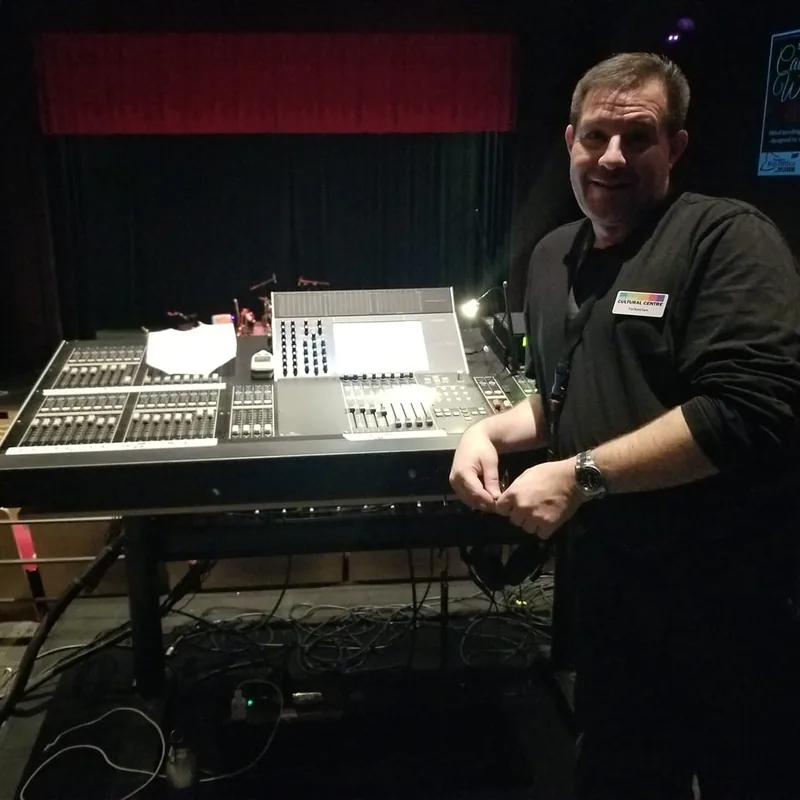
Gord Falk is a co-founder of Odeumate. He has spent decades building IT systems by day and nearly as long behind a sound console by night, including almost ten years as volunteer Technical Director at a community cultural centre, running sound, lights, and crew for musicals, concerts, and dance. He and his wife are longtime Broadway Across Canada subscribers, with seats right behind the soundboard. Some habits are hard to break.