

I was standing in the wings, waiting for my entrance cue, running my first lines in my head the way you do. And then a thought arrived that had nothing to do with my character: is my mic even on?
Nobody had told me. The tech was busy. The show was already running. I walked on stage and started talking, and for a beat or two I genuinely had no idea whether the 200 people in the house could hear me or whether I was projecting into a void.
That was my introduction to amplified community theater. It did not go well.
The production was Oliver!, and I was playing Mr. Brownlow. The role was not large enough to warrant a dedicated wireless pack, so I shared a mic with several other actors throughout the run. Shared mics mean logistics: handoffs between scenes, adjustments for costume differences, the quiet pressure of a cast member waiting in the wings for a pack you are still wearing. The mics were borrowed. The operator was learning on the job. Over a two-week run, we encountered a different problem each night. Some nights a wireless signal cut in and out without warning. Some nights feedback arrived mid-scene, mid-song, at exactly the wrong moment. Some nights the operator was focused on another actor when I made my entrance. I never walked to my first cue knowing what the evening's particular problem would be. That uncertainty alone occupied mental space that should have been occupied by my character.
I came away from that production with a very low opinion of microphones. I knew that this was unfair. I had spent years running sound before I ever set foot on a stage with a mic as a performer, and I never quite understood actors who blamed the gear. Now I was one of them.
I have not performed with a mic since. But I have been to community theater productions where the amplification was handled well. Really well. Sitting in the house, listening with the kind of ear that comes from years behind a board, I could not find the seams. Every word landed cleanly, including words from corners of the stage that would not have carried without help. Whatever was happening in the booth, it served the story instead of interrupting it.
And I revised my opinion. Not of microphones, exactly, but of what the real question actually is.
It is not about the mics
The choice to amplify or not is easy to frame as a philosophy debate. Purists will tell you that projection is a fundamental performance skill, that community theater exists to develop performers, and that microphones let actors get away with technique problems they should be fixing instead. Pragmatists will tell you that audiences today have been trained by film, television, and concerts to expect amplified sound, and that asking a volunteer cast to fill a 400-seat house with a live pit band running underneath them is simply unrealistic.
Both arguments are correct. That is why the debate keeps happening.
But the philosophy is almost beside the point in practice, because the question most community theater directors actually face is not "should we use mics?" It is "given this room, this cast, this show, and this budget, what gives the audience the best chance of hearing the story?" And the answer to that question is almost never purely one thing or the other.
When the room makes the decision for you
I have been in productions where the decision was obvious before rehearsals even started. A black box with 80 seats and no pit band: no mics needed, and adding them would have been a distraction. A 500-seat proscenium with an orchestra in the pit: anyone who argued against amplification had never tried to sing over a live brass section in a reverberant room.
Most community theaters operate somewhere in the middle, and that is where the real trade-offs live.
A mid-size venue of 200 to 300 seats with decent acoustics is the interesting case. Trained performers can project to fill it. But not every community theater cast is trained, and even trained performers have off nights. Projection is a skill that takes years to develop, and community theater runs on a mix of experience levels. The actor in the front row might carry the room beautifully. The actor in the back corner might not.
Some venues simply require amplification, full stop. A found space with low ceilings that swallow direct sound, an outdoor stage without shell support, a room that battles a live orchestra on every night of the run: in these spaces, projection is not going to save you. When the venue has already made the decision, the useful question shifts from whether to mic to how to do it well. Sound is often treated as the last item on the pre-production checklist. In these venues it probably should be the first.
I have been in un-mic'd productions where I was confident most of the audience could hear me. Most is doing a lot of work in that sentence. The people in the back row, the person with mild hearing loss in the third row on the side, the child who got distracted for a moment and lost the thread of the dialogue: they are all part of the audience too. When the house has to strain to follow the dialogue for two and a half hours, it is quietly tiring in a way that works against the story for the entire run. Projection gets you far, but it rarely gets you all the way there.
When mics help and when they hurt
Mics help when the room is too large or too live for consistent unaided projection, when the show has a musical score that will compete with the cast, or when the cast mix includes performers whose voices will not carry evenly. Done well, the audience hears everything, and the actors can trust that what they are doing is landing.
Mics hurt when the execution is poor. A cutting-in-and-out wireless system is worse than no system. Feedback is worse than a quiet back row. An actor who cannot project at all, and who has been told not to worry about it because they are mic'd, is developing a bad habit that will cost them later. And a borrowed rig with a first-time operator is not amplification, it is a liability.
The borrowed-rig situation is more common in community theater than anyone likes to admit. Wireless systems are expensive to buy and maintain. Skilled A1 operators are hard to find and harder to keep as volunteers. If the choice is between un-mic'd with a prepared cast and mic'd with borrowed equipment and an inexperienced operator, the honest answer is probably to go un-mic'd and work harder in rehearsal on projection and diction.
Two skill sets, not one
It helps to stop thinking about this as a binary choice and start thinking of it as a choice between two different disciplines, each of which demands real investment.
Performing without mics requires projection, enunciation, and rhythm. Every member of the audience needs to hear every word clearly, from the most urgent whisper to the angriest yell. These are skills that take years to develop. They do not arrive by accident, and they cannot be substituted by a good room or favorable acoustics. If a production is going un-mic'd, that decision should shape rehearsal from the beginning, not be treated as the default that requires no additional work.
Using mics requires a different skill set, and it runs in both directions: the actors need it, and so does the tech team.
Actors who have never performed with wireless packs need time to learn how to move in them, where to place them so they do not thump on costume changes, and how to trust that the house can hear them even when the stage monitors are not giving them a clear picture. That last point is harder than it sounds. Projection is partly psychological. When actors are uncertain whether they are being heard, they often compensate by pushing, which pulls the performance away from where it should be.
The tech crew has its own learning curve. An operator who has run several shows in this room, on this system, with this cast, makes real-time decisions that a first-timer simply cannot. They know which pack runs slightly hot. They know which actor always forgets to check their level before places are called. They know where feedback is most likely to find them and how close they can push the mix before it becomes a problem.
Building that mutual familiarity takes rehearsal time together, ideally before load-in. A sound check the afternoon before opening is useful, but it is not the same as running scenes with the crew present, letting the operator learn who speaks and moves where, and giving the actors time to hear themselves in the house. That kind of preparation builds the trust and the rhythm that makes a mic'd production feel effortless from the audience. When it is absent, the gaps tend to show up at exactly the wrong time: opening night, or the Saturday with a full house.
The thing nobody tells actors
If your theater is mic'd, find out before you walk on stage whether your mic is live.
This sounds obvious. It is not always practiced. On that first production, the information existed somewhere. Nobody passed it to the cast. I walked on not knowing, and that uncertainty took up mental space that should have been occupied by my character.
Shared mics add another layer to this. When a pack moves between actors, the person wearing it at any given moment may not be the person the operator is currently mixing. An actor can walk onstage with a live pack that is being used for someone else's entrance elsewhere, or with a pack that has been muted in preparation for a different scene. The handoff protocol matters as much as the initial check-in.
Good sound departments have a process for all of this: every mic tested, every actor confirmed, transitions accounted for, status communicated before places are called. If yours does not have one, ask for it. The actor's job is hard enough without having to guess whether anyone can hear them.
It depends on execution, not on the decision
Community theaters that have had a bad mic experience often swear off amplification entirely. That is an understandable reaction, but it is drawing the wrong lesson. The bad mic night was not caused by microphones. It was caused by borrowed gear and under-prepared operators. A bad un-mic'd production, where the audience strains to hear the dialogue for two hours, causes the same damage to the story and to the audience's goodwill. The gear is not the problem. The preparation is.
If your theater is considering amplification, the questions worth asking are: Do we have, or can we get, equipment that we own and maintain ourselves? Do we have an operator who knows the room? Do we have enough rehearsal time to train the cast and build the crew's familiarity with the show before opening night?
If the answers are yes, mics can serve the show well. If the answers are no, a clean un-mic'd production in a room sized for the cast you have may serve it better.
In many ways, the deeper question is not which technology to use. It is which skill set your organization is ready to develop and sustain. Amplified and un-mic'd are not opposing philosophies. They are different disciplines, and both of them are learnable. The production in front of you, the room you are in, and the audience that came to hear the story will tell you which path fits.
Part Two: From the Booth
Gord's view from the booth is now live: Tales from the Booth: To Mic or Not to Mic. The same question, a completely different set of problems.
Your Thoughts?
In the meantime, head over to our Facebook post and comment. Share your experience on the topic. While you're there, like and follow us.
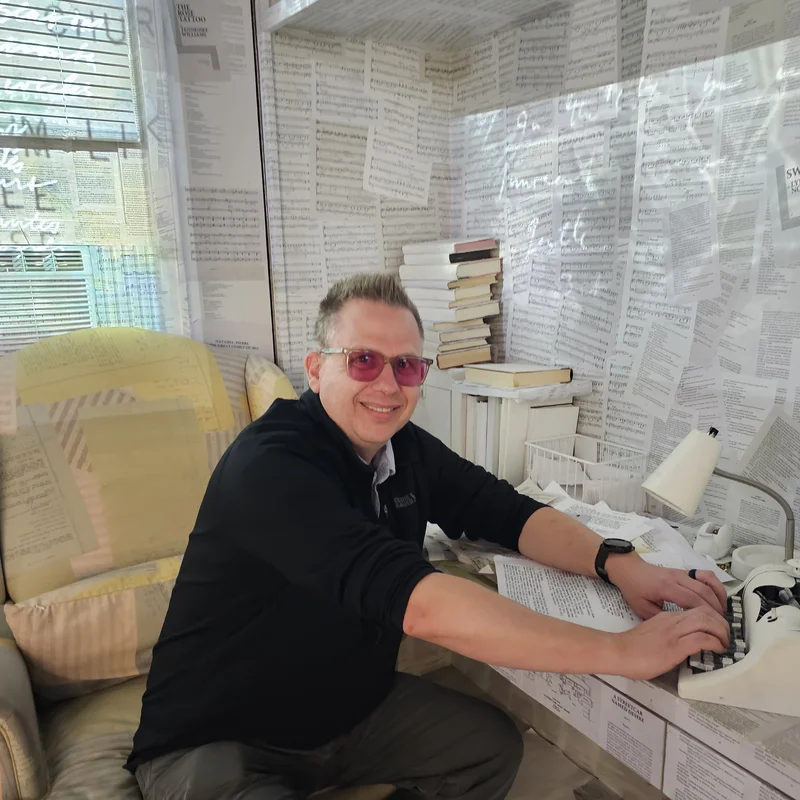
Glenn Howard is a co-founder of Odeumate and serves on the board of Chilliwack Players Guild. He has spent 30 years in IT and nearly as long on stage, and he built Odeumate because nothing else existed.